

Hotel guests rarely think about the systems working behind the scenes—until something goes wrong.
A room won’t cool down.
Wi-Fi slows to a crawl.
A door lock malfunctions.
A leak goes unnoticed until it becomes a costly problem.
These moments shape guest perception. As a result, the future of hospitality depends on preventing issues before guests ever experience them. That future is powered by AI.
From Reactive Fixes to Predictive Intelligence
AI-driven predictive intelligence allows hotels to move beyond reactive troubleshooting. Instead of responding after equipment fails or networks degrade, AI can identify risks early. In many cases, issues are forecast hours—or even days—before they affect operations.
This is where DzCore delivers measurable impact.
The Reality of Hotel Operations: Too Many Hidden Problems
Behind every smooth check-in, restful night, and positive review, thousands of micro-operations run continuously, including:
-
HVAC systems operating around the clock
-
Wi-Fi networks supporting hundreds of connected devices
-
Door locks and elevators dependent on stable connectivity
-
Pumps, chillers, and boilers cycling constantly
-
Energy consumption fluctuating across multiple floors
-
Water lines and drainage systems vulnerable to leaks
When even one of these systems slips, guest satisfaction declines and operational costs rise.
Why Predictive AI Changes Everything
In many hotels, problems are only discovered after a guest complains or a system fails. By contrast, predictive AI flips this model. It surfaces risks early, enables proactive intervention, and prevents issues before they disrupt guests or operations.
How AI Predicts Problems Before They Happen
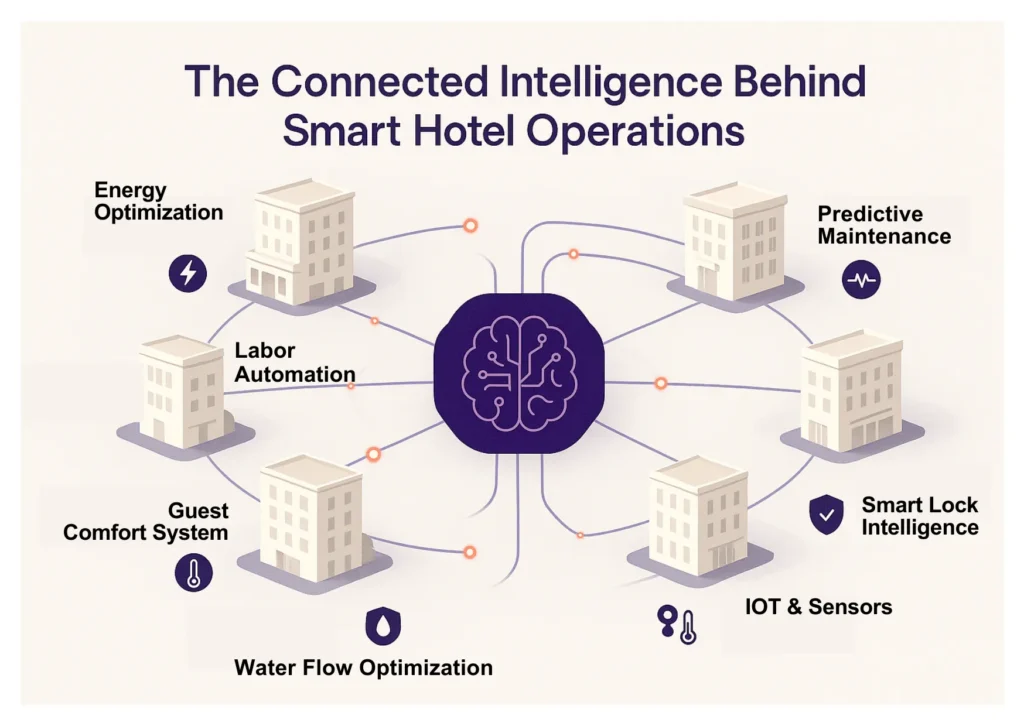
Modern AI is built to analyze patterns—temperature trends, vibration changes, occupancy behavior, network performance, energy usage, and more.By continuously learning what “normal” looks like inside a hotel, AI can flag anomalies that signal a future problem.
Examples include:
1. HVAC performance drifts before a breakdown
If the system starts using more energy than usual to cool a room, AI detects the inefficiency and triggers a maintenance alert.
2. Wi-Fi slowdowns caused by device overload
AI detects bandwidth saturation before guests experience buffering or dropped calls.
3. Water-flow irregularities indicating a hidden leak
A small change in sensor readings signals a leak hours before visible damage appears.
4. Energy spikes tied to malfunctioning equipment
AI identifies electrical anomalies that could turn into outages.
5. Smart lock failures predicted by connection instability
AI recognizes early communication drops and alerts engineering before lockouts occur.
This level of anticipation is only possible with sensors, connectivity, and the intelligence layer that turns data into action.
How DzCore Enables Predictive Hospitality
DzCore is designed specifically to help hotels prevent failures—not just repair them. Each service plays a role in enabling predictive intelligence:
DzAssist: On-Demand Expert Support
When AI flags an issue, DzAssist provides the hands-on help needed:
remote troubleshooting, guidance, and dispatch coordination to keep everything running smoothly.
DzLink: Stable Connectivity for All Devices
Predictive intelligence requires reliable communication.
DzLink ensures sensors, smart devices, locks, and guest-facing systems stay online and stable—critical for accurate detection.
DzSense: The Eyes and Ears of the Property
DzSense works like IoT sensors that monitor leaks, temperature, humidity, HVAC performance, water flow, and equipment health.
These sensors feed real-time data into the DzCore ecosystem, creating the foundation for AI prediction.
DzTrack: Real-Time Asset Tracking & Health Monitoring
DzTrack tracks the status and performance of operational assets.
AI models use this data to identify abnormal patterns or early signs of malfunction.
DzPortal – Unified Operational Visibility
With DzPortal, all analytics, alerts, and performance insights appear in a single dashboard.
This enables engineering, IT, and management teams to act quickly—without switching tools.
DzIntel: The Predictive Brain of DzCore
This is where the intelligence comes together.
DzIntel analyzes cross-property data, identifies risks, and delivers predictive alerts long before failures impact guests.

The Guest Never Notices—And That’s the Point
With predictive AI:
The room stays cool.
The Wi-Fi stays strong.
The leak never becomes a flood.
The door lock never fails.
The energy bill stays manageable.
Hotels avoid negative reviews, prevent costly emergency repairs, and elevate their brand reputation by simply staying ahead of problems.
This is the modern standard for hospitality operations—and DzCore is engineered to support it at scale.
The Future of Hospitality is Proactive
Hotels that embrace AI-driven predictive operations gain:
✔ Lower operational costs
✔ Fewer emergency breakdowns
✔ Higher guest satisfaction
✔ More efficient teams
✔ Better asset longevity
✔ Real-time multi-property oversight
The new era of hospitality is not just smart—it’s predictive.
And with DzCore’s integrated ecosystem of sensors, connectivity, tracking, monitoring, and intelligence, every hotel can operate with the reliability and efficiency the industry now demands.
Optimize Your Hotel Operations With DzCore
Hotels operate best when issues are solved before they reach the guest. With DzCore’s integrated suite:- DzSense
- DzLink
- DzTrack
- DzIntel
- DzPortal
- DzAssist
If you’re ready to reduce disruptions, protect guest satisfaction, and streamline engineering and IT operations, DzCore is built for you.
👉 Learn more about DzCore’s hospitality solutions.
DzCore FAQs
AI analyzes patterns from IoT sensors, equipment performance, and network activity to detect anomalies. This allows hotels to identify issues—such as HVAC strain, leaks, or Wi-Fi congestion—before they affect guests.
Most hotels only need IoT sensors and stable connectivity. DzSense and DzLink provide the sensor network and device connectivity required for predictive intelligence.
Yes. Predictive alerts help engineering teams address problems early, reducing emergency repairs, preventing equipment downtime, and extending asset lifespan.
Not with DzCore. DzPortal centralizes all data and alerts into a single dashboard, making multi-property visibility easy for engineering, IT, and management.
No. It enhances staff performance by reducing manual checks, preventing unexpected issues, and allowing teams to focus on higher-impact guest-facing tasks.

Rami El Chafei, CEO of DzAani, where his passion for innovation and hospitality converge. A visionary with deep industry expertise, Rami has guided Dzaani to become a pioneer in hotel technology services. His leadership fuels the development of the DzCore Unified Operations Platform—helping hotels simplify tech management, enhance connectivity, and deliver exceptional guest experiences.

About DzAani: DzAani is a global hospitality technology and managed services provider helping hotels and property operators enhance guest experience and operational efficiency through AI and IoT. Our DzCore program delivers comprehensive managed services—combining support, monitoring, connected sensors, asset tracking, cybersecurity, and lifecycle management—to properties worldwide.