

The hotel room of tomorrow won’t look dramatically different. Guests will still expect comfort, functionality, and ambiance. However, behind the scenes, a major shift is underway. Connected sensors are turning hotel infrastructure into intelligent systems. These systems communicate, predict issues, and optimize performance in real time.
In hospitality, the true power of IoT isn’t in guest-facing gadgets. Instead, it lies in operational intelligence. Hotels gain continuous awareness of what’s happening across the property. They can anticipate issues before they escalate. Decisions become data-driven, reducing costs while improving guest experience.
For operators, this represents a fundamental shift. Manual checks and reactive monitoring give way to predictive operations powered by constant data streams. With IoT in place, hotels can:
Monitor assets continuously without manual intervention
Detect early warning signs of failure
Optimize energy and resource usage
Improve reliability across critical systems
As this shift accelerates, the question changes. It’s no longer whether IoT will transform hospitality. It’s how quickly hotels can take advantage of its competitive edge.
The Data Blind Spots That Cost Hotel Millions
Most hotels rely on two unreliable information sources:
✓ Scheduled inspections
✓ Reported problems
Maintenance checks happen on predetermined schedules, leaving long gaps where issues can grow unnoticed. Meanwhile, guest complaints often surface only after a problem becomes severe.
This creates costly blind spots:
A slow leak can go undetected for weeks—until it causes thousands in water damage.
An HVAC unit may run inefficiently for days, causing energy waste before anyone notices poor cooling performance.
Properties often lack real-time visibility into energy consumption, equipment health, and system anomalies.
This outdated model leaves teams reacting to emergencies instead of preventing them.
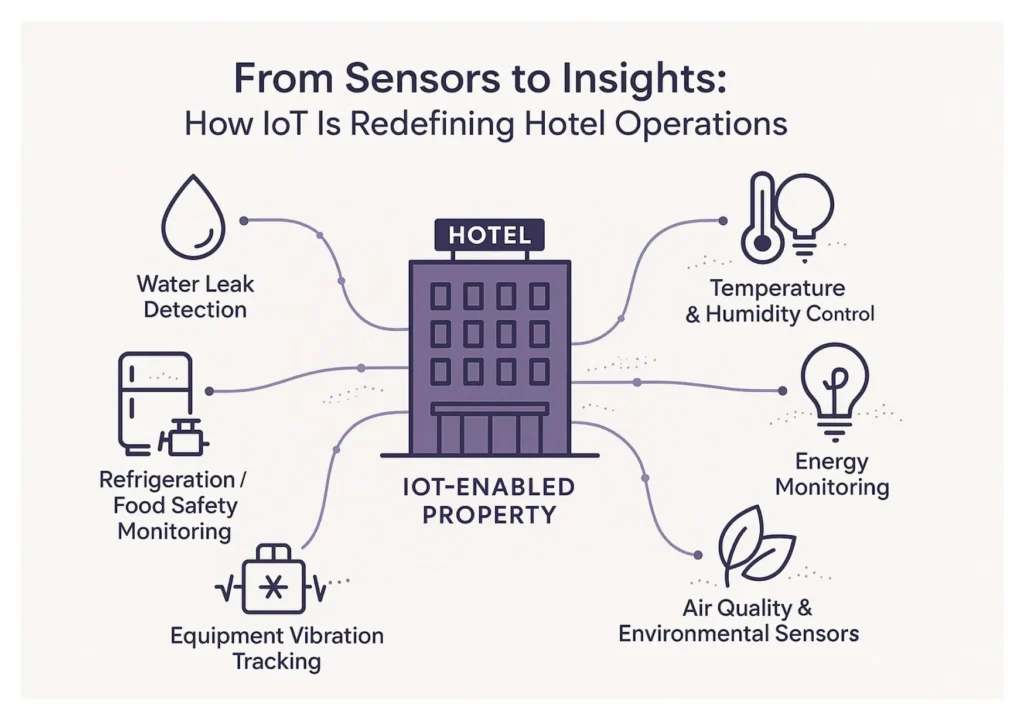
Making the Invisible Visible With Sensor Intelligence
IoT sensors eliminate blind spots by providing continuous real-time data across critical systems.
DzSense deploys strategic sensor networks that monitor:
Water leaks in mechanical rooms and high-risk zones
Temperature & humidity for optimal comfort and equipment health
Energy consumption at the equipment level
Vibration patterns that signal motor or compressor failure
Door and access activity for operational insights and security
Air quality and environmental safety metrics
But collecting data isn’t enough. DzSense transforms raw sensor data into actionable intelligence:
Alerts trigger instantly with exact location details
Mobile notifications accelerate response times
Escalation rules ensure no alert is missed
Dashboards visualize conditions across the entire property
What was once invisible becomes visible—and manageable.
Predictive Maintenance Powered by Historical Intelligence
Real transformation begins as sensor data accumulates over time. Each data point adds context. Patterns emerge. Insights deepen.
Machine learning models trained across hundreds of properties analyze this data continuously. As a result, they identify patterns that signal equipment failure weeks in advance.
Take HVAC systems as an example. Before a compressor fails, early warning signs often appear, including:
Slightly abnormal vibration levels
Increasing temperature fluctuations
Gradual spikes in energy consumption
These signals are easy for humans to miss. However, trained AI models detect them instantly and consistently.
Predictive maintenance delivers compounding benefits across operations:
Fewer emergency repairs
Extended equipment lifespan
Reduced operational costs
Improved capital planning
More efficient staff allocation
Across large property portfolios, the impact multiplies. The system learns from every asset, every property, and every anomaly, strengthening predictions and improving outcomes over time.

Energy Optimization: The Shift From Monitoring to Active Management
Energy is one of a hotel’s largest controllable expenses—yet often the least understood.
IoT-enabled energy management gives hotels equipment-level visibility:
Which HVAC systems consume the most energy
Which lighting zones waste power
Which appliances run inefficiently
How occupancy affects load patterns
Advanced systems go further with active optimization:
Smart thermostats adjust to occupancy
Lighting systems adapt automatically
HVAC loads shift to off-peak periods
Pre-heating/cooling strategies reduce demand charges
These continuous micro-adjustments—impossible to perform manually—translate to significant annual savings without compromising guest comfort.
Environmental Monitoring: Protecting Assets and Guest Health
IoT sensors safeguard both property and guest wellbeing:
Air quality sensors maintain healthy ventilation
Humidity sensors prevent mold and material damage
Refrigeration sensors ensure food safety and compliance
Water temperature sensors reduce Legionella risk
Freezer/cooler monitoring prevents spoilage and audit failures
This continuous oversight replaces slow, manual inspections with real-time assurance and digital documentation.
Integrated Intelligence: Why Platforms Matter
Sensors by themselves are not a strategy. The real value comes from integration.
DzSense unifies all sensor data into a single operational dashboard:
Maintenance teams view alerts, historical data, and sensor locations
Mobile apps close the loop from detection to resolution
Automated correlation identifies shared causes across multiple sensors
Predictive insights align with occupancy schedules for ideal intervention timing
Instead of fragmented systems, teams operate on one cohesive platform with full visibility.
ROI- Beyond Cost Savings: The Strategic Value Proposition
Hotels often justify IoT investments through direct savings:
Reduced energy consumption
Prevention of water damage
Extended equipment life
Fewer emergency repairs
But the strategic benefits are even more valuable:
Improved guest satisfaction and reputation
Fewer operational disruptions
More efficient staff deployment
Stronger capital budgeting
Continuous operational improvement through data
IoT becomes not just a cost reducer—but a performance accelerator.
Implementation Done Right: Why Managed IoT Matters
IoT requires:
Reliable connectivity
Proper sensor placement
Continuous platform maintenance
Staff training
Alert management
DIY deployments often fail because they create fragmented data without actionable intelligence.
DzSense solves this with a managed IoT service, including:
Expert design and installation
Unified platform integration
24/7 monitoring
Regular updates and enhancements
Scalable improvements as technology evolves
Hotels gain the benefits without the complexity.
The Competitive Imperative
IoT has moved from futuristic concept to operational necessity. Hotels that delay adoption risk higher costs, lower efficiency, and reduced competitiveness.
Those who adopt early gain:
Predictive, efficient operations
Stronger guest satisfaction
A reputation for reliability
Real-time operational visibility
The gap between IoT-ready hotels and traditional operators widens every year.
Turn Your Data Into Operational Excellence
DzSense delivers full IoT monitoring, AI-driven analytics, and round-the-clock support that convert sensor data into actionable intelligence. Integrated with the broader DzCore suite—including support, cybersecurity, asset management, and network monitoring—DzSense enables unified operational excellence.
Ready to transform your hotel operations?
Contact DzAani or visit dzaani.com to explore IoT solutions designed specifically for hospitality.
DzSense Q&A
IoT refers to interconnected sensors and devices that collect real-time data from equipment and environments, enabling hotels to monitor, predict, and optimize operations automatically.
Sensors detect early warning signs—such as abnormal vibration, leaks, or temperature changes—allowing teams to repair issues before they escalate into expensive emergencies.
Not with a managed service like DzSense. Sensors are installed strategically, integrated into a unified dashboard, and supported 24/7 without requiring hotels to maintain the technology themselves.
Yes. Equipment-level energy monitoring and automated optimization reduce consumption, minimize waste, and lower demand charges.
By preventing disruptions—such as HVAC failures, uncomfortable room conditions, or service delays—and ensuring reliable operation across the entire property.
Is sensor data secure?
DzSense uses secure, encrypted communication and adheres to industry best practices to protect operational data and system access.

Rami El Chafei is the CEO and driving force behind DzAani, , where innovation and hospitality converge. With a deep understanding of hotel operations and emerging technologies, he has led DzAani to redefine how properties manage their digital infrastructure.
Through DzCore, the company’s AI- and IoT-powered Unified Operations Platform, Rami is helping hotels simplify technology management, improve asset visibility, and deliver seamless guest experiences. His work embodies a clear mission: transforming hospitality operations through intelligence, automation, and human-centered design — all powered by Dalos.