

In an industry where margins are measured in percentage points and guest expectations continue rising, the traditional approach to cost management—cutting services, reducing staff, or delaying maintenance—creates a dangerous paradox. Every dollar saved through reduced service quality potentially costs more in lost bookings, negative reviews, and damaged reputation. Yet operational costs continue climbing while competitive pressure keeps rate increases limited.
Smart hotels have discovered a fundamentally different approach to cost optimization. Rather than compromising guest experience to reduce expenses, they’re leveraging intelligent technology to eliminate waste, optimize operations, and deliver superior experiences at lower cost. The key insight: most operational inefficiencies are invisible to manual management but obvious to intelligent systems continuously monitoring performance and identifying optimization opportunities.
This isn’t about technology for technology’s sake. It’s about using connected systems, predictive analytics, and automated optimization to achieve what seemed impossible—simultaneously reducing costs and improving guest satisfaction. The properties achieving this aren’t cutting corners; they’re eliminating waste that guests never valued while investing those savings in experiences that drive loyalty and revenue.
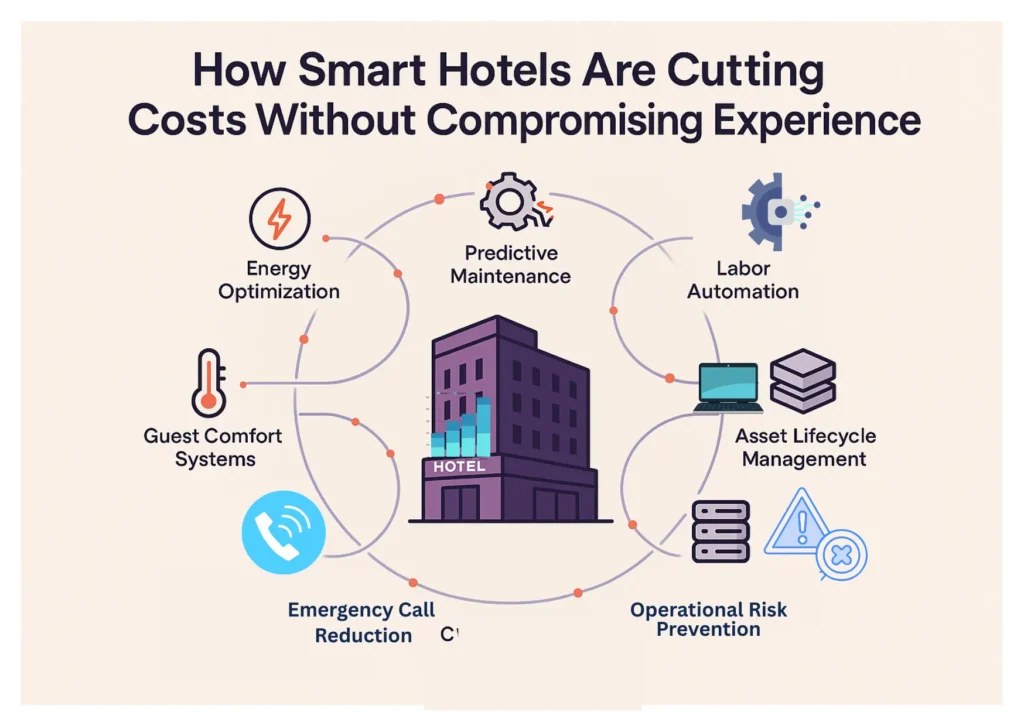
The Hidden Cost Centers Most Hotel Ignore
Traditional hotel cost management focuses on obvious line items—labor, inventory, vendor contracts. But the largest opportunities for savings often hide in operational inefficiencies that don’t appear on standard financial reports. Energy waste from equipment running inefficiently. Emergency repairs costing three times normal rates because predictive maintenance wasn’t performed. Network downtime driving guests to competitors. Staff time consumed by repetitive tasks that could be automated.
Consider energy consumption, typically the second-largest controllable expense after labor. Most hotels know their total utility costs but have no visibility into where that energy is actually consumed. An HVAC system running at 80% efficiency instead of optimal performance might cost an extra $50,000 annually, but without granular monitoring, the waste remains invisible. Multiply these hidden inefficiencies across dozens of systems and hundreds of rooms, and the financial impact becomes substantial.
DzCore’s integrated approach makes the invisible visible. By monitoring energy consumption at the equipment level rather than just whole-property meters, properties gain precise visibility into where costs are occurring and where optimization opportunities exist. When an HVAC unit starts consuming 15% more energy while producing less cooling, the system doesn’t wait for complete failure—it alerts maintenance to investigate a probable efficiency problem that, left unaddressed, would waste thousands of dollars before eventually requiring emergency repair at premium cost.
The financial impact extends beyond direct cost savings. Properties gain accurate data for capital planning, negotiating power with vendors armed with performance metrics, and ability to benchmark systems across the portfolio to identify underperforming equipment or optimize purchasing decisions.
Predictive Maintenance: From Emergency Costs to Planned Efficiency
The true cost of equipment failure extends far beyond the repair bill. Emergency service calls command premium rates—often 2-3x normal pricing. Rush-ordered replacement parts cost more and may require expensive overnight shipping. But the largest costs are often indirect: guest complaints about room temperature or hot water, staff time managing the crisis, and potential revenue loss if rooms must be taken out of service.
Traditional time-based maintenance schedules attempt to prevent failures through regular service intervals, but this approach has inherent inefficiencies. Equipment gets serviced whether it needs attention or not, wasting labor and parts. Yet failures still occur between scheduled services because time-based intervals can’t account for actual operating conditions and usage patterns.
DzSense IoT sensors enable condition-based maintenance that intervenes precisely when needed based on actual equipment status rather than arbitrary schedules. Vibration sensors on motors detect bearing wear before failure. Temperature and current monitoring on electrical equipment identifies degradation. Runtime tracking ensures maintenance occurs at optimal intervals based on actual use rather than calendar dates.
The cost advantages compound across multiple dimensions. Planned maintenance during low-occupancy periods costs less than emergency service during peak times. Early intervention prevents secondary damage—a failing compressor caught early might need bearing replacement; caught late, the entire unit needs replacement. Maintenance teams can schedule work efficiently when they know what issues to expect, rather than responding reactively to crises.
Properties implementing predictive maintenance typically report 25-40% reduction in maintenance costs while simultaneously reducing equipment downtime. The return on investment often occurs within the first year as emergency service calls decrease and equipment lifespan extends through better care.
Energy Optimization: The Savings That Never Stop
Energy management represents perhaps the most compelling business case for smart hotel operations. Unlike one-time improvements, energy optimization delivers ongoing savings month after month, year after year. And unlike cost reductions that might impact guest experience, smart energy management maintains or improves comfort while reducing consumption.
Basic building automation can reduce energy costs, but intelligent systems leveraging AI and occupancy data achieve dramatically better results. Rather than simply following predetermined schedules, adaptive systems learn building thermal characteristics, integrate weather forecasts, and adjust operations dynamically based on actual occupancy rather than assumptions.
Pre-conditioning provides a clear example of intelligent optimization. Traditional systems maintain constant temperatures in all spaces. Smart systems predict occupancy based on reservations and historical patterns, then pre-condition spaces just before guests arrive rather than maintaining temperature continuously. A room vacant for two days doesn’t need full conditioning—but it needs to be perfect when the guest checks in. This simple optimization can reduce HVAC costs for that room by 60% during the vacancy period without any impact on guest experience.
Load management delivers another layer of savings. Commercial electricity rates often include demand charges based on peak usage, sometimes representing 30-50% of total costs. Intelligent systems can shift non-critical loads to off-peak periods—laundry during night hours, ice machine production when demand is low, pre-heating or pre-cooling buildings using lower overnight rates rather than expensive daytime power.
DzLink‘s network monitoring ensures energy-saving measures don’t compromise the connectivity guests increasingly demand. There’s no value in reducing HVAC costs if poor Wi-Fi performance drives guests to competitors. The integrated approach optimizes across multiple dimensions simultaneously rather than sub-optimizing individual systems in isolation.
Portfolio operators report typical energy cost reductions of 15-25% after implementing intelligent optimization, translating to hundreds of thousands in annual savings for large properties. These savings flow directly to profitability while supporting sustainability goals increasingly important to corporate clients and environmentally conscious travelers.
Labor Optimization Through Intelligence Automation

Labor represents the largest operational expense for most hotels, making it the most scrutinized area for cost reduction. But the traditional approach—reducing headcount or limiting hours—directly impacts service quality and guest satisfaction. Smart properties take a different approach: using technology to eliminate repetitive administrative work so staff can focus on value-adding guest interactions.
Consider the IT support workload at a typical property. Staff members call about password resets, printer issues, Wi-Fi problems, and various technical questions. Each call consumes time from both the property employee and whoever provides tech support. Many issues are simple and repetitive—problems that could be resolved automatically or prevented entirely with proper monitoring.
DzAssist‘s proactive support model fundamentally changes this dynamic. Rather than waiting for employees to report problems, the system monitors devices and infrastructure continuously, identifying and often resolving issues before users notice them. Password resets can be handled through automated self-service. Wi-Fi problems get detected and resolved before they impact operations. Printers report low toner levels automatically, triggering reorders before supplies run out.
The labor savings extend beyond just technical support. When systems work reliably, staff doesn’t waste time troubleshooting or working around failures. When issues do occur, automated diagnostics provide clear information about root causes, eliminating time wasted on trial-and-error problem solving. When maintenance is predictive rather than reactive, technicians can work efficiently with proper parts and tools rather than making multiple trips.
Properties report that automation typically eliminates 20-30% of routine administrative tasks, freeing staff time for guest-facing activities that actually drive satisfaction and loyalty. The cost savings come from improved productivity rather than reduced headcount—the same team can manage more effectively with better tools and less crisis management.
The ROI of Reduced Downtime
When network connectivity fails, a modern hotel doesn’t just lose internet access—it loses operational capability. Point-of-sale systems stop working. Reservation management goes offline. Door locks may fail. Staff can’t access guest information. The property effectively ceases functioning as guests expect in 2024.
The direct costs of such outages are obvious: lost revenue from frustrated guests, emergency IT service calls, potential comps or discounts to address complaints. But the larger costs are harder to quantify: damaged online reputation from negative reviews, lost future bookings from guests who choose competitors, staff frustration and potential turnover from working in constant crisis mode.
Proactive monitoring through DzLink prevents most outages before they impact operations. Network devices showing degraded performance get flagged for investigation before failure. Bandwidth utilization trends identify capacity issues before they cause slowdowns. Security vulnerabilities get patched before they’re exploited. The system doesn’t just alert when things break; it predicts problems days or weeks in advance.
The financial impact of prevented downtime often exceeds the cost of the monitoring service itself. A single prevented outage during peak check-in hours—avoiding lost revenue, emergency service calls, guest complaints, and reputation damage—can justify months of monitoring costs. Properties that experience fewer emergencies also benefit from reduced stress and improved employee morale, contributing to better retention in an industry with notoriously high turnover.
Asset Lifecycle Management: Planning Replaces Crisis
Smarter Capital Planning with DzTrack
At many hotels, capital expenditure planning still happens reactively. Assets are used until they fail unexpectedly, forcing emergency replacements that disrupt operations, inflate costs, and require rushed purchasing decisions. This reactive cycle drives higher capital spend while limiting opportunities for strategic planning.
DzTrack changes this by providing real-time visibility into how physical assets are actually used across the property. By tracking the location, movement, utilization frequency, and operational patterns of equipment and mobile assets, hotels gain a clear understanding of which assets are heavily relied on, underutilized, or approaching operational limits.
Instead of guessing when equipment needs replacement, operators can use DzTrack data to plan capital investments based on real usage rather than age alone. An HVAC unit or service vehicle showing consistently high utilization can be scheduled for replacement during planned renovations or low-occupancy periods—avoiding emergency downtime and allowing procurement teams to secure favorable pricing through advance planning.
Across multi-property portfolios, the financial advantages compound. DzTrack enables operators to identify usage patterns across locations, standardize asset deployment, and balance resources more effectively. Underutilized equipment can be redeployed instead of replaced, while high-demand assets can be prioritized for proactive investment. This reduces unnecessary purchases while improving operational availability.
DzTrack also improves repair-versus-replace decisions. When maintenance teams can see how often an asset is used, how frequently it moves, and how long it remains active each day, decisions are no longer based on instinct. Instead, they’re guided by objective utilization data that clarifies whether continued investment in repairs makes sense or if replacement will deliver better long-term value.
Hotels using utilization-driven planning typically see 15–20% longer asset lifespans through smarter deployment, along with 30–40% reductions in emergency replacement costs. By aligning capital decisions with real-world asset behavior, DzTrack helps hotels cut costs while maintaining operational reliability—without compromising the guest experience.
Operational Risk Costs: Peventions vs Remediation
Operational disruptions—not cyber threats—represent one of the largest hidden cost drivers in hospitality. Network slowdowns, asset misuse, unplanned equipment downtime, inefficient workflows, and delayed response to anomalies all create ripple effects that increase costs and degrade guest experience. As with security, the financial impact depends heavily on approach: reactive response costs far more than proactive prevention.
Reactive operations force teams to respond after problems escalate. A missed early warning leads to emergency repairs, guest complaints, service recovery costs, overtime labor, and lost revenue. What begins as a minor performance deviation can quickly become a costly operational incident when teams lack visibility and predictive insight.
DzIntel addresses this challenge by transforming operational data into actionable intelligence. By analyzing patterns across network performance, IoT sensor readings, asset utilization, and historical incident data, DzIntel identifies anomalies and emerging risks before they disrupt operations. Instead of reacting to failures, teams intervene early—when issues are still inexpensive and easy to resolve.
The true cost of operational disruption extends beyond immediate fixes. Guest dissatisfaction impacts reviews and repeat bookings. Staff productivity suffers when teams are forced into constant firefighting. Leadership loses confidence in forecasting when operational surprises become the norm. Over time, these indirect costs often outweigh the direct expense of repairs.
By centralizing insights through DzPortal, DzIntel ensures that the right teams see the right information at the right time. Unified dashboards replace fragmented reports, enabling faster decisions and coordinated action across departments. Preventive insights reduce manual oversight while improving consistency across properties.
Prevention-driven operations consistently cost less than remediation. Identifying inefficiencies, performance degradation, or abnormal behavior early avoids emergency spending and protects guest experience. In practice, preventing even a single major operational disruption often offsets months—or years—of intelligence-driven monitoring and optimization.
The Guest Experience Multiplier
Perhaps the most compelling aspect of smart hotel operations is that cost reductions often improve rather than compromise guest experience. When systems work reliably, guests notice the seamless experience rather than technical friction. When energy optimization maintains perfect room temperature, guests experience comfort without awareness of the efficiency behind it. When predictive maintenance prevents equipment failures, guests simply enjoy uninterrupted service.
This creates a virtuous cycle where cost savings fund experience improvements that drive occupancy and rate growth. Money saved on energy waste can be invested in room upgrades. Labor savings from automation allow staff reallocation to guest-facing services. Reduced emergency spending frees budget for amenities that differentiate the property from competitors.
Properties tracking both operational costs and guest satisfaction metrics consistently report that smart operations improve both simultaneously. Guest satisfaction scores increase while costs decrease—the exact opposite of what happens when properties cut costs through traditional approaches like reducing services or deferring maintenance.
The competitive implications are significant. Properties that achieve superior economics through operational efficiency can either increase profitability at current rates or compete more aggressively on price while maintaining margins. Either way, they gain market share against competitors still operating with inefficient traditional approaches.
Building the Busines Case: ROI That Scales
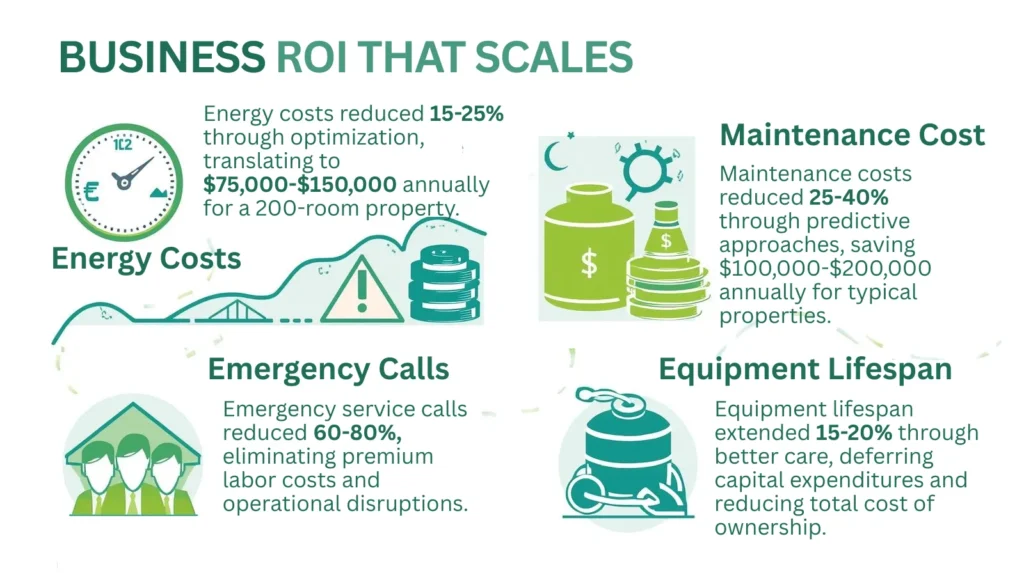
CFOs evaluating smart hotel technology investments want clear answers about return on investment and payback periods. The compelling aspect of platforms like DzCore is that ROI improves with scale. A single property gains significant benefits, but portfolio operators multiply advantages across all properties while spreading platform costs.
Direct cost savings typically fall into several categories, each with measurable financial impact: Energy costs reduced 15-25% through optimization, translating to $75,000-$150,000 annually for a 200-room property. Maintenance costs reduced 25-40% through predictive approaches, saving $100,000-$200,000 annually for typical properties. Emergency service calls reduced 60-80%, eliminating premium labor costs and operational disruptions. Equipment lifespan extended 15-20% through better care, deferring capital expenditures and reducing total cost of ownership.
But direct savings tell only part of the story. Operational improvements enable revenue growth that amplifies ROI. Improved guest satisfaction drives higher occupancy and ADR. Reduced downtime captures revenue that would be lost during outages. Better online reviews attract new guests. Enhanced reliability supports premium positioning in the market.
Portfolio operators report typical payback periods of 12-24 months, with ongoing annual benefits continuing indefinitely. The platform becomes more valuable over time as data accumulates, predictive models improve, and operations teams develop expertise in leveraging the capabilities. This compounding value creation makes smart operations not just a cost reduction initiative but a strategic competitive advantage that improves continuously.
The Competitive Imperative
The hospitality industry has entered a phase where operational efficiency increasingly separates winners from losers. Properties still operating with manual processes and reactive approaches face growing disadvantage against competitors leveraging intelligent systems to optimize costs while improving experience. The performance gap widens over time as smart properties accumulate data, refine operations, and compound their advantages.
For many operators, the question is no longer whether to implement smart operations technology but how quickly they can capture the advantages before losing market position to early adopters. The properties achieving both lower costs and superior guest experiences aren’t fortunate—they’re strategic, investing in platforms that deliver measurable ROI while building sustainable competitive advantages.
Start Cutting Costs While Improving Experience
DzCore enables smart hotel operations through integrated managed services that simultaneously reduce costs and enhance guest experience. From predictive maintenance that eliminates emergency expenses to energy optimization that cuts utility costs by 15-25%, from proactive monitoring that prevents costly downtime to asset management that extends equipment life 15-20%—every module delivers measurable ROI while improving operations.
Ready to discover how much your properties could save while delivering better guest experiences? Contact DzAani for a customized cost analysis showing potential savings from smart operations, or visit dzaani.com to explore how DzCore transforms hotel economics through intelligent management.

Rami El Chafei is the CEO and driving force behind DzAani, , where innovation and hospitality converge. With a deep understanding of hotel operations and emerging technologies, he has led DzAani to redefine how properties manage their digital infrastructure.
Through DzCore, the company’s AI- and IoT-powered Unified Operations Platform, Rami is helping hotels simplify technology management, improve asset visibility, and deliver seamless guest experiences. His work embodies a clear mission: transforming hospitality operations through intelligence, automation, and human-centered design — all powered by Dalos.