

The hospitality industry is in the midst of a fundamental transformation. Guest expectations have evolved beyond comfortable beds and quality service—today’s travelers demand seamless connectivity, personalized experiences, and frictionless technology that simply works. Yet behind the scenes, many hotel operations teams are still managing IT infrastructure the old way: reactive troubleshooting, fragmented vendor relationships, and round-the-clock firefighting that drains resources and impacts guest satisfaction.
The truth is, traditional IT management models weren’t designed for the complexity of modern hospitality operations. Between maintaining network uptime across multiple properties, managing IoT devices, coordinating with multiple vendors, and ensuring operational visibility, hotel teams are stretched thin. The result? Downtime that frustrates guests, maintenance backlogs that compound over time, and inefficiencies that erode profitability.
It’s time for a new approach. The managed services revolution in hospitality IT isn’t just about outsourcing support—it’s about fundamentally rethinking how technology enables operations, protects assets, and enhances the guest experience.
The Breaking Point: Why Traditional IT Models Fail Hotels
Most hotels rely on a patchwork of IT solutions built over time. One vendor manages the network. Another handles point-of-sale systems. A third supports security cameras. When something fails at 2 a.m., the gaps become clear. There is no single point of contact. There is no unified view of the problem. And there is no clear path to resolution.
As a result, this fragmented approach creates serious vulnerabilities.
First, it leads to finger-pointing when issues arise. Vendors shift blame instead of fixing the problem. Resolution slows, and guests lose access to essential services.
Second, fragmentation blocks visibility. Properties can’t see how systems interact or fail together. This makes it difficult to:
Identify recurring issues
Detect early warning signs
Predict failures before they occur
Optimize system performance
Third, hotel staff absorb the burden. Teams meant to focus on guest experience become informal IT coordinators. They chase vendors, manage escalations, and troubleshoot issues while trying to keep operations running.
Meanwhile, the true cost extends well beyond IT budgets. Network downtime frustrates guests who need to work or stream content. Delayed maintenance allows small issues to grow into costly failures. System gaps put guest experience and brand reputation at risk. In an industry where online reviews directly impact occupancy, technology failures carry real business consequences.
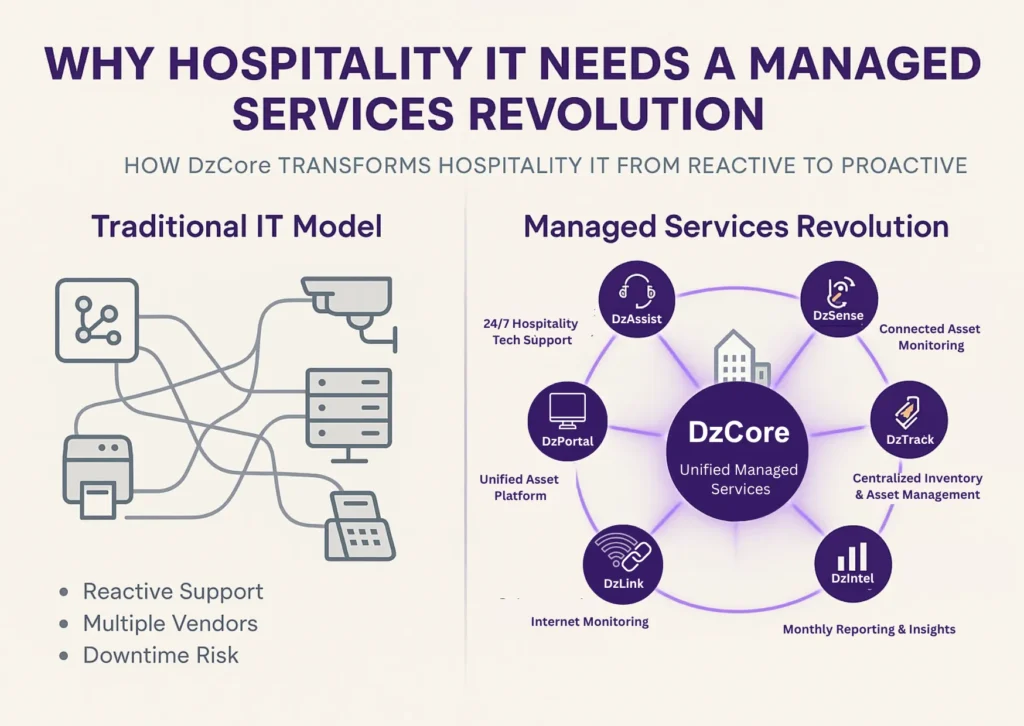
What Makes Managed Services Different: The DzCore Advantage
True managed services for hospitality represent a complete paradigm shift from traditional IT support models. Instead of reactive, break-fix relationships with multiple vendors, properties gain a unified technology partner that proactively monitors, maintains, and optimizes every aspect of their digital infrastructure—24 hours a day, 365 days a year.
This is the foundation of DzCore, DzAani’s comprehensive managed services program designed specifically for the hospitality industry. Rather than treating technology as a collection of isolated systems, DzCore integrates six core service modules into a seamless operational framework that covers everything from network monitoring to IoT intelligence and asset management.
DzAssist
DzAssist provides round-the-clock technical support, ensuring hotel staff always have expert help available regardless of time zone or property location. Whether it’s a front desk terminal freezing during check-in or a conference room display failing before a major event, help is immediate—not after navigating phone trees, but now.
DzLink
Dzlink continuously monitors network infrastructure and Wi-Fi performance across all properties, using AI-driven diagnostics to identify and resolve connectivity issues before guests ever notice them. This proactive approach transforms IT from a cost center into a strategic advantage that consistently delivers the connectivity modern travelers expect.
DzSense
DzSense deploys IoT sensors throughout properties to monitor conditions like temperature, water leaks, energy use, and equipment health. These sensors generate actionable insights that prevent costly damage, reduce utility expenses, and enable predictive maintenance that keeps assets performing longer.
DzTrack
DzTrack provides real-time visibility into vehicles, mobile assets, and equipment across geofenced property areas, allowing operations teams to prevent loss, optimize deployment, and ensure resources are always where they’re needed most.
DzPortal
DzPortal centralizes control of property systems, maintenance schedules, and performance dashboards in one unified platform—giving operations teams clear, data-driven oversight instead of juggling multiple systems and spreadsheets.
DzIntel
DzIntel delivers advanced analytics and reporting capabilities, helping hotel leaders make smarter decisions based on trends, asset performance, and operational data collected across all DzCore modules. This intelligence layer drives continuous improvement and strategic growth.
The Business Case: ROI Beyond Cost Savings
When hospitality executives evaluate managed services, the discussion often begins with cost. Can IT spending be reduced? In most cases, the answer is yes. Consolidating vendors cuts overlap. Eliminating redundancies lowers waste. Preventing emergency repairs avoids unexpected expenses. Together, these actions deliver measurable savings. However, focusing only on cost overlooks the bigger opportunity.
The real return comes from operational transformation. Instead of reacting to failures, properties improve continuously. IT teams shift from firefighting to proactive work. Staff spend less time troubleshooting and more time supporting guests. At the same time, operations teams gain real-time visibility into asset health and system performance. Decisions become data-driven, not based on assumptions.
Network uptime illustrates this shift clearly. Traditional IT models define success by how quickly issues are fixed. By contrast, managed services programs like DzCore define success by preventing issues altogether. This proactive approach leads to:
Fewer service interruptions
Reduced guest complaints
Higher satisfaction scores
Stronger revenue performance
Predictive maintenance delivers similar long-term value. Rather than running equipment until it fails, IoT sensors and analytics surface risks early. Issues are identified weeks or even months in advance. This allows teams to:
Schedule maintenance during low-occupancy periods
Extend the lifespan of critical assets
Avoid guest-facing disruptions
Protect both reputation and profitability
Building for Scale: Why 300+ Propertise Trust DzCore
DzAani’s DzCore program currently supports over 300 properties worldwide—from boutique hotels to major resorts. This isn’t a pilot initiative—it’s a proven operational model delivering consistent results across diverse property types and markets.
Supporting hundreds of properties requires robust systems, standardized processes, and a service structure that ensures consistent quality regardless of geography. This scale creates a continuous improvement loop—insights from one property enhance the performance of all others, while shared data fuels smarter predictive models and better outcomes.
The Path Forward: From Revolution to Evolution
The managed services revolution in hospitality IT isn’t just about adopting a new vendor—it’s about embracing a fundamentally different operational model. Hotel leadership must think of technology as a driver of experience and efficiency, not merely a cost center.
For properties still relying on traditional, reactive IT models, the question isn’t if they should evolve—it’s when. The gap between leaders who’ve adopted managed services and those who haven’t will only widen as guest expectations and operational complexity continue to grow.
The good news? The model is proven. Programs like DzCore deliver measurable improvements in uptime, efficiency, and satisfaction while simplifying operations across every property.

Ready to Transform Your Operations?
DzCore keeps over 300 properties running seamlessly through integrated managed services that combine 24/7 support, AI-driven monitoring, IoT intelligence, and proactive asset management.
If you’re ready to move beyond reactive IT firefighting and embrace a managed services model built for hospitality, we’d love to connect.
Learn more at dzaani.com or contact our team to schedule a consultation.
About the Author

Rami El Chafei is the CEO and driving force behind DzAani, , where innovation and hospitality converge. With a deep understanding of hotel operations and emerging technologies, he has led DzAani to redefine how properties manage their digital infrastructure.
Through DzCore, the company’s AI- and IoT-powered Unified Operations Platform, Rami is helping hotels simplify technology management, improve asset visibility, and deliver seamless guest experiences. His work embodies a clear mission: transforming hospitality operations through intelligence, automation, and human-centered design — all powered by Dalos.